First published in AUSTRALIAN CINEMATOGRAPHER – June 2026 Print Edition
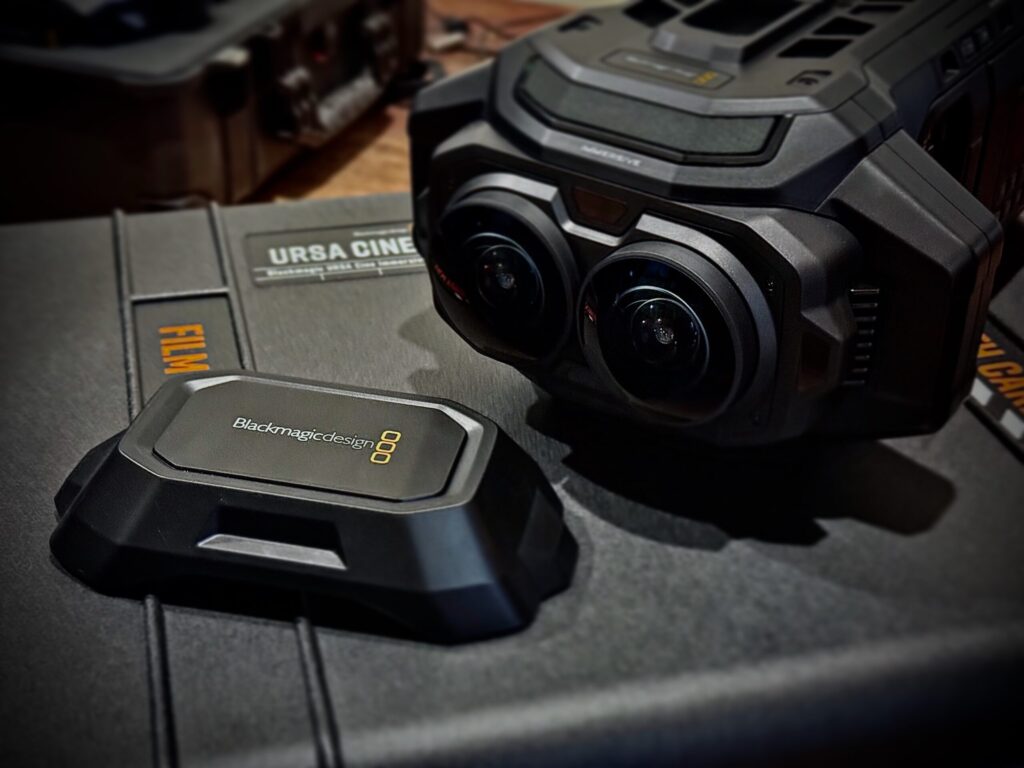
What is the URSA Cine Immersive?
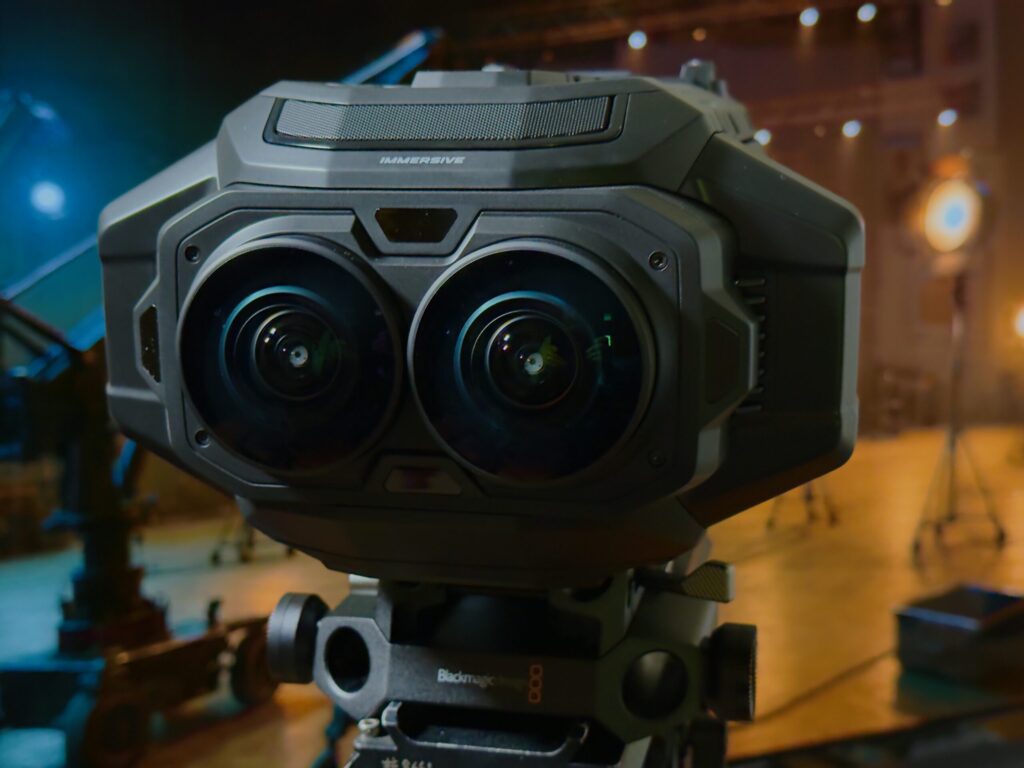
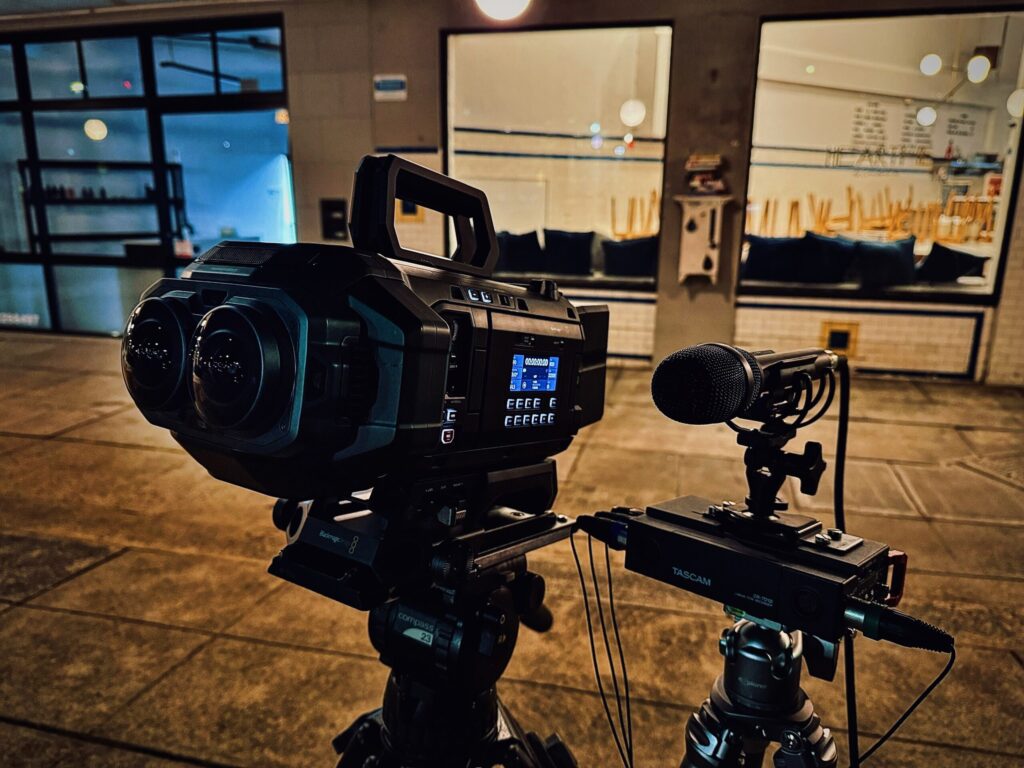
The URSA Cine Immersive is a unique looking camera and the reason is very simple… it is designed to capture moving images for an entirely new format and in doing so meet some previously unheard-of technical specifications.
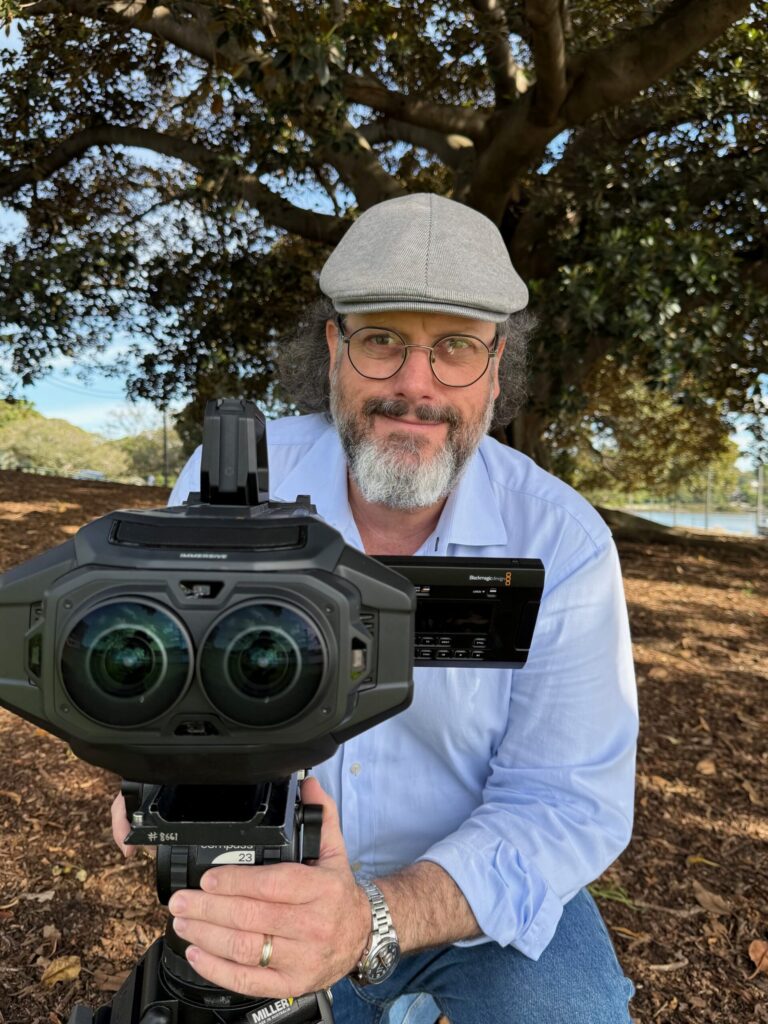
I’ve been lucky to be one of the first cinematographers in the world to start using the URSA Cine Immersive camera and have done the first documentary shot in the southern hemisphere and the first drama project in the world to have been shot on the camera.
What is Apple Immersive Video?
Apple Immersive Video is a new professional format designed deliver images and sound in a 3D, wraparound format with levels of clarity, accuracy and realism which are technically closer to those experienced in real life than any previous immersive formats, including VR.
The format is designed specifically to play back in Apple’s first spatial computer… the Apple Vision Pro and while it may look like a VR headset from the outside, it contains a fully functional computer which runs on a new type of operating system called “visionOS” controlled by the user’s eyes and hands rather than a keyboard and mouse or track pad.
Apple Immersive Video or AIV requires a unique combination of resolution, frame rate and angle of view, all with an angle of view upwards of 180º, in stereoscopic 3D and without visual distortion. It is also accompanied by a new 3D sound format called the Apple Spatial Audio Format (ASAF) which allows a matching level of clarity and precision to in the sound design.
The URSA Cine Immersive Camera
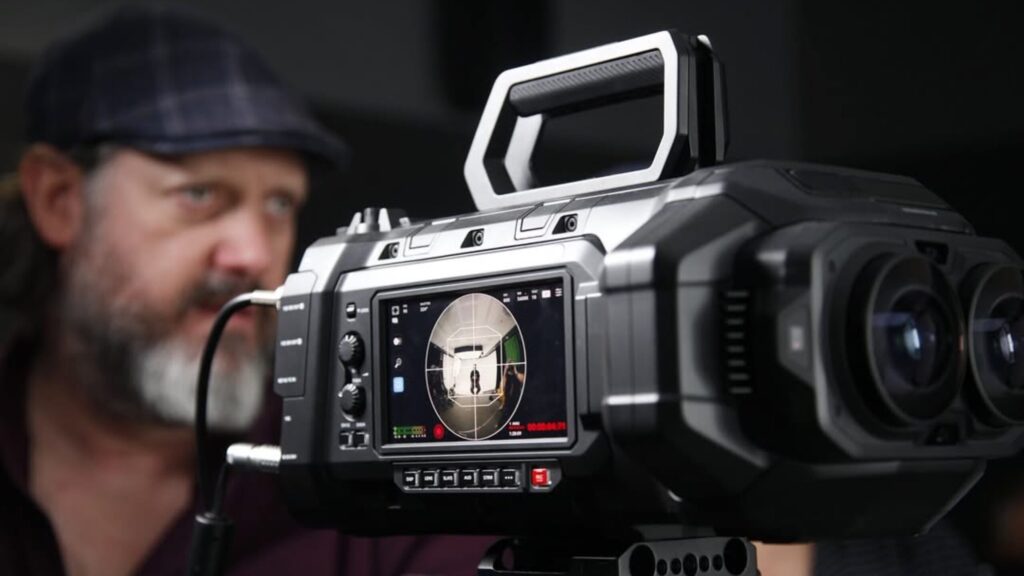
The Cine Immersive is the first camera on the market to meet the rigorous requirements of the AIV format. The images are 8160 x 7200 per eye and at the 90 fps required to avoid the headaches and nausea caused by lower frame rates in other immersive formats.
From the large-format image sensors back, it is physically the same design as the other two cameras in Blackmagic’s new high-end cinema camera lineup, the URSA Cine 12K LF and the URSA Cine 17K 65. These cameras have recently been making remarkable inroads into the very tough Hollywood market, most notably with the Steve Carell series ROOSTER, shot on the 65mm variant by Blake McClure ASC and the most recent season (Season 3) of SHRINKING, shot by our very own John Brawley ACS.
The left and right eye stereoscopic streams which are recorded together in a single BRAW file which carries the perfectly synchronised and aligned left and right eye images together through the whole post pipeline, eliminating most of the operational complexity normally associated with stereoscopic.
The lenses are a custom design to match the requirements of the camera and are 7.4mm f4.5. These lenses are hard mounted to the camera in the factory at what I believe is a sub-pixel accuracy requirement to enable the special AIV calibration process to be carried out.
Essential Calibration & Metadata
As Cinematographers, when we think of camera metadata, it would usually be in reference to the useful bits of additional information which modern cameras can record alongside the pictures which can be helpful in post-production.
The AIV metadata is in a completely different category and is essential for the viewer to properly and comfortably experience an Immersive film.
In the factory, the camera goes through a special calibration process, designed by Apple which maps the photo-sites of the individual image sensors, through the glass of their specific, permanently mounted lens to a precise angle out into the real world. This is packaged as an Immersive Lens Profile Data or ILPD file which is loaded into the camera and is recorded inside every BRAW Immersive clip it shoots.
This file is unique for each Immersive camera and is attached to each clip and travels all the way to the files that are played back in the Vision Pro where the ILPD is used to remap the pixels back out to their correct position, relative to the individual viewer’s eyes. This all happens seamlessly in the background both for the film makers and the viewers.
Data Rates & The Media Module
BRAW is one of the most robust and efficient camera codecs available, which is lucky because the URSA Cine Immersive camera produces a mind-boggling quantity of data. Compared to 4K digital cinema systems which deliver 212 million pixels second, the URSA Cine Immersive generates over 10.5 billion pixels every second.
Even at the recommended 12:1 compression setting, the Immersive camera produces almost twice as much data as the uncompressed ARRIRAW from the ALEXA 65.
This creates some new challenges for data management, dailies and backups, which should be carefully considered before commencing any AIV production. Even DIT’s and post houses used to dealing with large amounts of footage from high end cameras may need to rethink their processes and resources in order to keep up with the quantity and pace of data flowing from the Immersive camera.
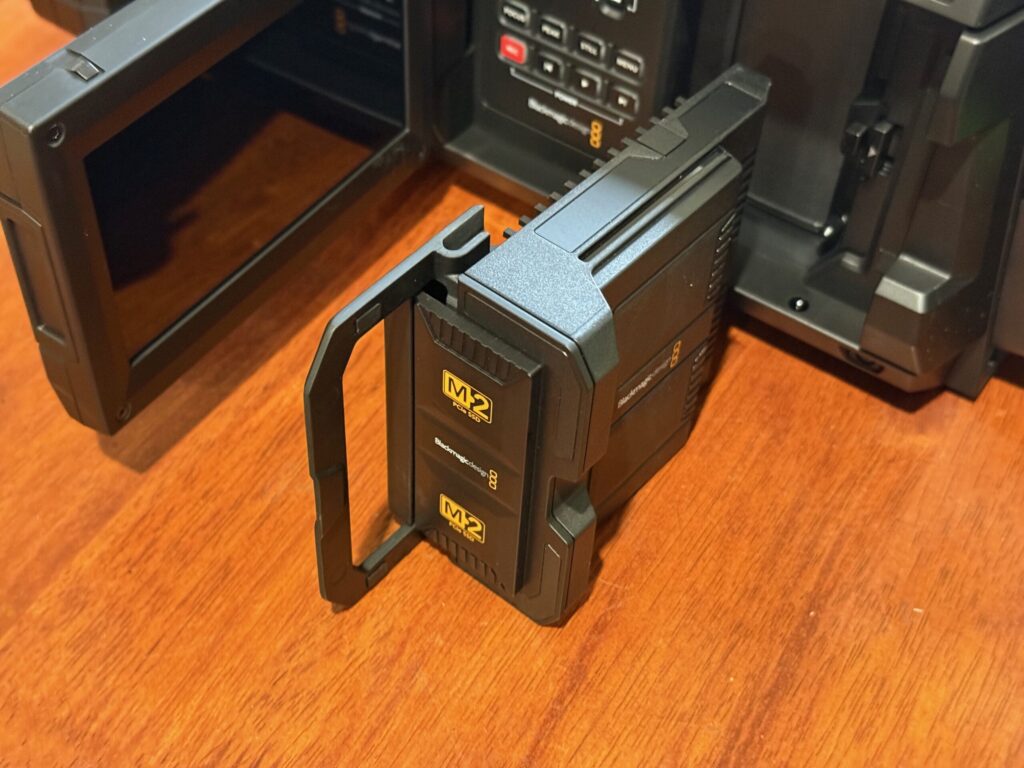
In camera, this data flow is made possible by the Blackmagic Media Module, which is a specially designed SSD hardware raid in a housing which facilitates robust physical protection, heat dispersion and hot swappable use, ideal for the normal pressures of on-set work.
The footage can be offloaded either directly from the camera’s 10 gigabit ethernet port or using the Blackmagic Media Dock, which allows up to three Media Modules to be mounted simultaneously via 10G ethernet or USB C.
The camera comes with one 8 TB Media Module which allows for approximately 105 minutes at 12:1. The Media Modules are now also available in a 16 TB option.
Cinematography without Lens Changes, Focus, Iris, Zoom or Filters
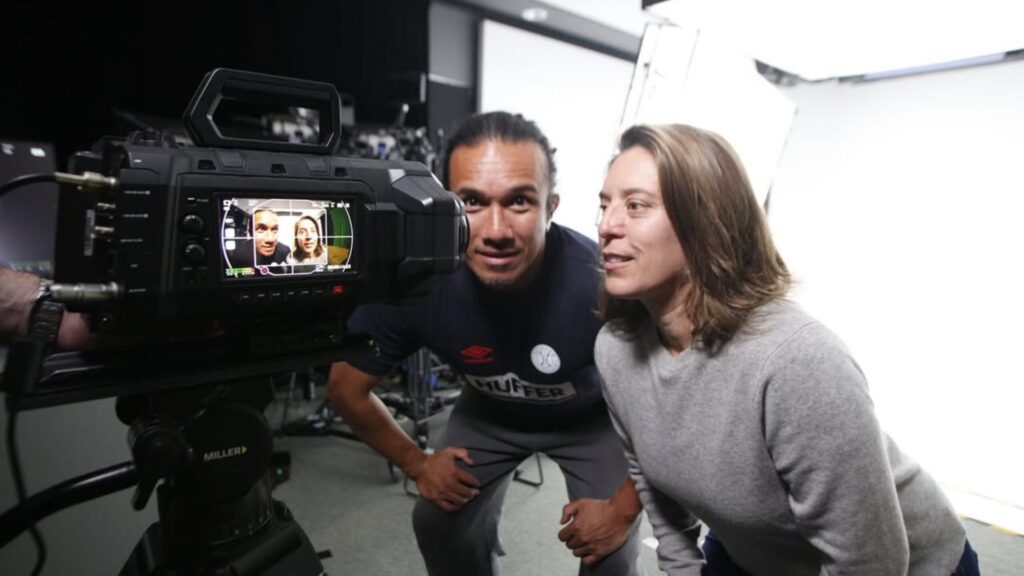
The first shock as a cinematographer when you start learning to work with the URSA Cine Immersive is that much of what we think of as central parts of the cinematographer’s process are suddenly off the table.
The lenses are fixed, they are the only option and they can’t be altered. Despite this, working in Immersive really means thinking about lenses differently. Traditional formats can use different focal lengths to change the relationship between the camera and the subject and as result the subject and the background. These relationships function in a completely different way in Immersive and the payoff for this is the 1:1 relationship the viewer has to the captured world of the shot.
When the URSA Cine Immersive is placed in a position in the real world, the viewer watching that shot in the Vision Pro can see everything the camera sees at its correct size, proportions and distance. We intuitively understand these things from everyday life and in AIV production this is referred to as Proximity… one of the “Three P’s” of AIV (Proximity, Perspective and Perceptual Salience).
If the proximity of the camera to the subject feels uncomfortably close for two people in real life, it will feel too close in AIV. But if the camera is set at an appropriate distance and Perspective the moment will feel natural and comfortable for the viewer. Instead of using different focal lengths to create the illusion of different proximity and perspective, in AIV it is possible to capture the actual sense proximity and perspective and for the viewer to accurately experience it.
Focus plays out in a similar way. There is no focus adjustment on the camera and the lenses have focus fixed to produce depth of field which stretches from about 1m to infinity. This is important because in the Vision Pro, the viewer has the freedom to look anywhere in the shot and because we’re used to our eyes instantly adjusting their focus to whatever we’re looking at. The look in the Vision Pro can often be very similar to the effects we traditionally create with shallow depth of field. I’ve been able to identify several contributing factors for this.
First is the basic reality that with accurate depth perception, we’re not relying on things like depth of field to create an artificial sense of depth… you get that “for free” …straight out of the camera.
Then there is the fact that on playback in the Vision Pro, our eyes still need to adjust their convergence for the distance of the object we’re looking at, just like in the real world. This means that objects in the background appear as double-images and less distinct. You can experience this right now by holding a finger in front of you, as close as you can focus on it and then notice how objects in the distance appear. AIV playback in the Vision Pro follows the same laws and just like in real life you can “focus” on something close to the camera or something off in the distance and the physical experience matches what you would experience in everyday life.
Thirdly, we aren’t usually conscious of how little of our field of view in real life is actually in sharp focus. In reality we only see full sharpness in the central 2-5º of our vision and over about 20º either side it drops off drastically. We feel like we see a sharp view everywhere because much of what we “see”, is actually constructed in the brain from tiny fragments of sharp vision, gathered as our eyes dart around the scene in front of us. Because our eyes focus instantly on whatever we look directly at, we feel as if everything is sharp at once through this sharp mental model of the world. When watching AIV in the Vision Pro, this also means that anything the viewer is not looking at directly, is not sharp to their eyes.
This all adds to the sense of “cinematic” depth of field which is constantly adapting to whatever the viewer is choosing to look in a way that is natural but also has the potential to be a powerful tool when used with creative intent.
The fixed Iris would also appear to be a difficult issue, but in practice can be managed very effectively by a combination of ISO, the built in ND filters and lighting. While f4.5 at 90 fps does not lend itself to low light situations, this is one of many aspects of working with the Cine Immersive camera which have more in common with shooting film than what we generally expect from digital.
Obviously if we can’t change lenses then the fixed focal length lenses don’t offer the ability to zoom, but this is also not a bug but a feature, because as soon as you zoom in or out, it is impossible to maintain the 1:1 scale and depth.
There are the internal ND filters, which are essential for daylight use and are superb quality IRND’s.
With a 180º field of view any matte-box would be in shot and for a filter to cover the full image, it would have to be shaped like a goldfish bowl around the lenses. But more importantly, any glass element that the light passes through will affect the characteristics of the optical path and therefore the accuracy of the ILPD.
The first application to deal with this issue will be underwater housings and Gates Underwater have announced they have a solution for this about to be released. No information has been released yet on how this is being achieved, but they have said that this housing will be a rental only item, probably paired with a specially recalibrated camera.
No Pan or Tilt either
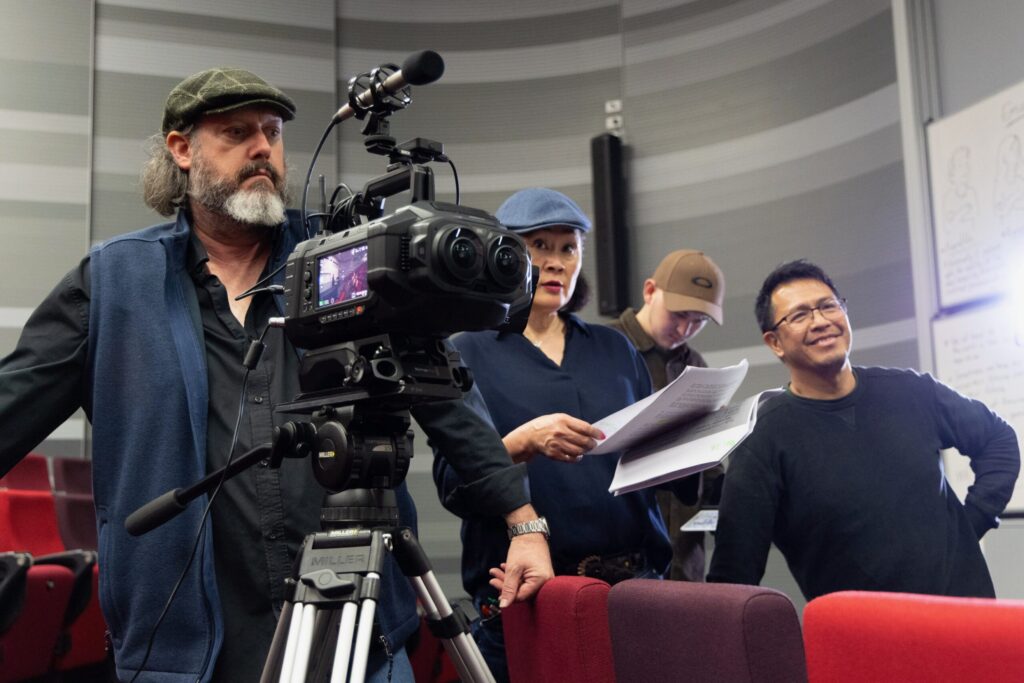
This is not a hard and fast rule, but in general, traditional pan and tilt movements register as the world spinning around the viewer rather than the camera moving.
One of the big lightbulb moments for me in this Immersive journey was realising that in AIV, the viewer has such a clear and stable view of the world around them, so many of the movements that a skilled operator would usually do become instinctual for the ordinary viewer.
For example, someone riding a horse across a distant ridgeline is something we would often cover on a long lens, with the operator smoothly tracking the movement of the horse and rider. In AIV, the same moment would best be captured with a completely static camera and the viewer’s eyes instinctively follow the horse and rider, just as they would in real life.
Much of what we do as professionals operating the camera, is to replicate within a frame, what we all do naturally with our eyes.
It’s not an exaggeration to say that much of the camera operator’s role in framed formats becomes a collaboration between the operator and the viewer in Immersive.
Using the camera
The first thing to notice about the Cine Immersive is that it is a true professional cinema camera, not a point and shoot style camera like most VR cameras.
It has most of the controls you would expect including physical switches for ISO, shutter and white balance along with assignable function buttons and multiple record triggers around the camera body.
The menu system follows the clear and intuitive structure now standardised across all of Blackmagic’s cameras, and despite the complexity of the Immersive format, anyone familiar with professional cinema camera systems will be able to quickly find their way around the menu system.
It also has standard professional connections such as dual XLR for audio input, dual 12G SDI for monitoring output and BNC for timecode input.
The camera also has multiple USB C ports which can be used variously for monitoring, software updates and for transferring files without using the ethernet port.
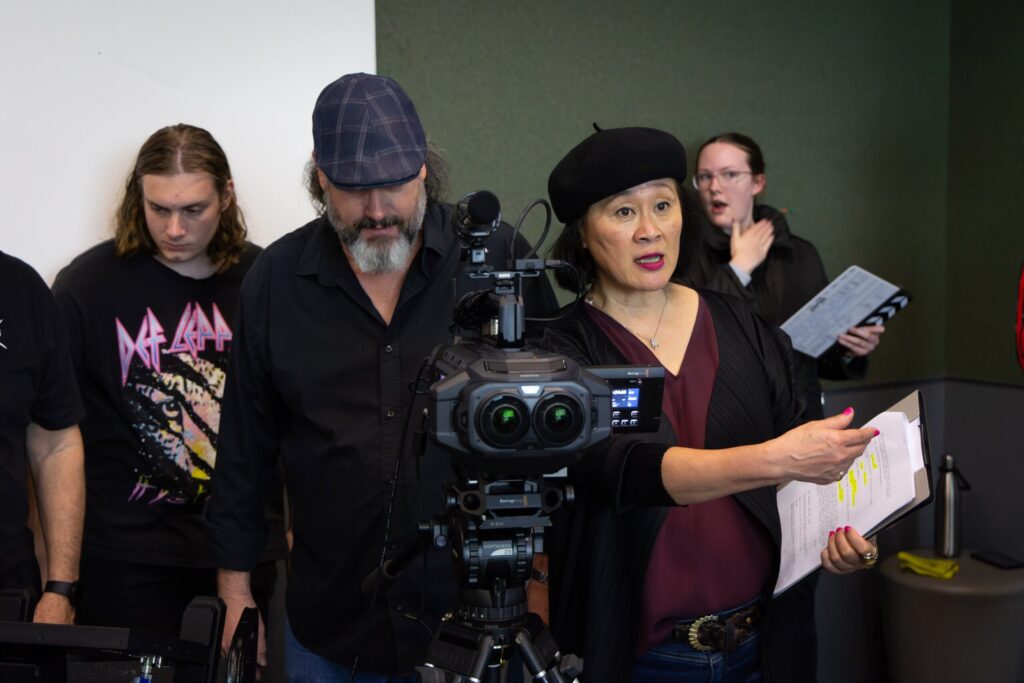
The next thing you will notice is how fast and simple the camera is to set up. Compared to a traditional digital cinema camera, the Cine Immersive is ready to shoot with hardly any additional equipment. The lenses are built in, there’s no matte-box, follow focus or remote lens controls. You can literally mount it on a tripod, insert the Media Module put on a battery and start shooting.
Connecting additional gear for TC, monitoring and audio happens just as it would on any modern high end camera.
Timecode
With the camera recording at 90 fps and no other equipment (particularly audio recorders and TC systems) available which can operate at 90 fps Apple and Blackmagic have come up with an elegant solution. As long as all of the external TC devices are operating at 30 fps (not 24 or 29.97) the camera will internally convert that to 90 fps.
DaVinci Resolve Studio is then able to recognise that the 90 and 30 fps timecodes go together and is able to sync them accurately without any extra action from the user.
Monitoring
The camera can output a standard 1080p HD or 2160p UHD signal via the SDI connections and this is also down-converted to 30 fps for compatibility with existing video monitors.
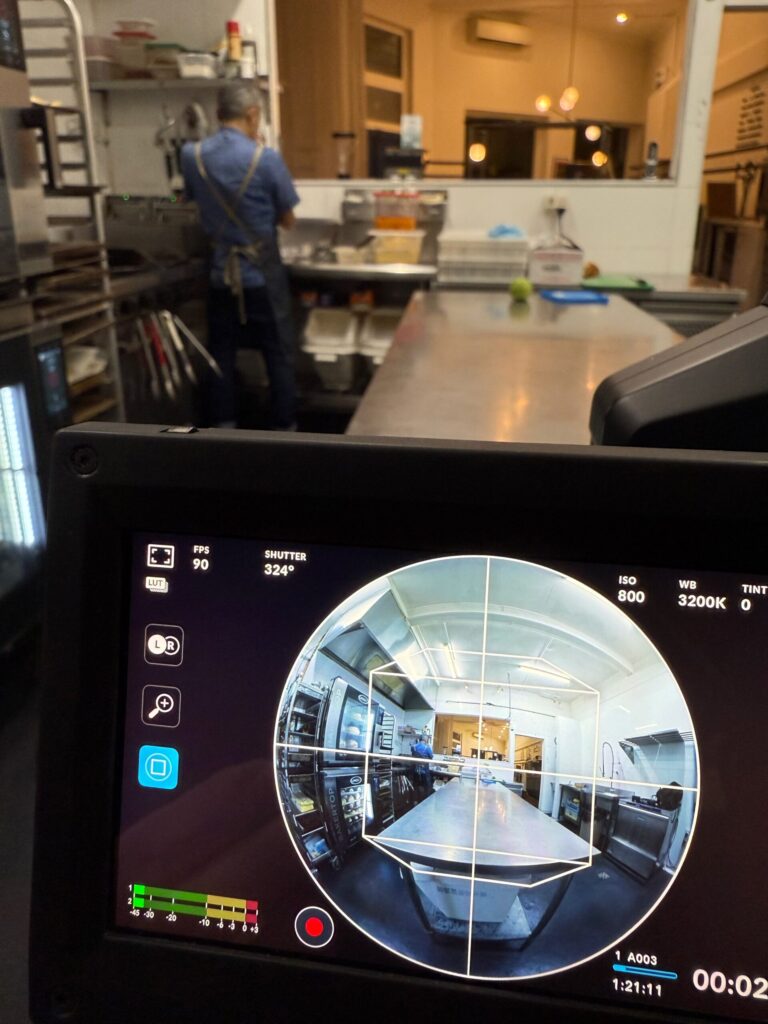
The image via these outputs is the full 210º captured by the lenses rather than the 180º intended for final use, which is the version displayed on the built in monitors. In post-production this edge masking is controllable and can be varied shot by shot as required and can have customised shapes and feathering.
The two built in 5 inch displays can be used for both monitoring the image and as touch screens for accessing and controlling the menu system. They have special overlay markings designed specifically for shooting Apple Immersive with a central shape that approximates what the viewer will see in the Vision Pro when looking straight ahead. These markings also have full length vertical and horizontal reference points which are particularly useful in Immersive.
I’ve found it very helpful to use the Horizon overlay feature because it is generally best to keep the camera completely level and allow the viewer to look up or down as the content requires. When the Horizon markers match up with the horizontal and vertical reference lines, you know that the camera is perfectly level on both the tilt and the roll axes.
Lighting – No Backlight or Sidelight
There is, but only if you can either hide the source within the scene or are happy to have the lamp visible in shot. The 180º view both horizontally and vertically means that any light source which is out of shot, is some sort of front light.
As with many of the other challenges, this isn’t as bad as it first sounds. The use of practicals can be very effective, lighting through a door or window can be very effective. Because the equivalent of close-ups, the close proximity shots, need to be done with the subject quite close to camera, a key light for these shots can actually be positioned out of shot but with enough of an angle to provide some nice shading to the face.
The other realisation is that many of the things that we use lighting for such as creating a sense of depth in the face and getting separation from the back ground, are built into the 3D image. Good lighting is still good lighting, but I’ve found the limits to be much easier to work within than I imagined.
The Immersive Future
It is still very early days for the Apple Immersive Video format and the Vision Pro ecosystem, but from what I’ve seen it is very clear that the company is deeply committed to both for the long term.
The combination of the URSA Cine Immersive camera system and the AIV workflows in DaVinci Resolve have made it accessible and practical for productions outside of Apple to start creating films in this new format. Like IMAX, AIV is a specialised niche but I expect that, also like IMAX, it will become increasingly mainstream. Having spent so much time watching AIV in the last year, I do occasionally find myself looking at a cinema or TV screen and wondering to myself… where’s the rest of the picture?